


 +65 6221 1768
Corporate Tax in Singapore — What Startups Need to Know
Understanding your tax obligations and opportunities is an important part of setting up your new business for growth. The corporate tax system in Singapore is known for being clear and…
Understanding your tax obligations and opportunities is an important part of setting up your new business for growth. The corporate tax system in Singapore is known for being clear and offering good incentives to help businesses from the start. Knowing the rules about the Singapore corporate tax rate, exemptions, and compliance can help founders and small and medium-sized businesses save a lot of money and build a stronger foundation.
This guide explains the most important ideas, incentives, and rules about corporate taxes that you need to know in order to make smart choices for the future of your startup.
1. Learning about the Singapore Corporate Tax Rate
The main corporate tax rate in Singapore is a flat 17%. This competitive rate applies to a company’s taxable income, which is its revenue minus the business expenses it can deduct.
People often think that all profits are taxed at 17%. Because of different exemption programs, a startup’s effective tax rate is often much lower, especially in the first few years of business.
2. Important Tax Breaks for New Businesses
This is where Singapore’s business-friendly environment really stands out. Two main plans can make your taxes a lot less.
a) The Start-Up Tax Exemption (SUTE)
The SUTE is a great reason for new businesses to start up. To be eligible, your business must be registered in Singapore, be a tax resident for that Year of Assessment (YA), and have no more than 20 shareholders during the basis period. All of these shareholders must be individuals, or at least one must be an individual who owns at least 10% of the shares.
How it works starting in YA 2020:
| Chargeable Income (CI) | Tax Exemption |
|---|---|
| First $100,000 | 75% exempt from tax |
| Next $100,000 | 50% exempt from tax |
This means that only S$62,500 of your first S$200,000 in chargeable income is subject to the 17% corporate tax. The tax rate you pay on the first S$200,000 is about 5.3%.
b) The Partial Tax Exemption (PTE)
Companies that don’t qualify for SUTE (for example, after their first three YA or if they have corporate shareholders) will automatically get the Partial Tax Exemption.
Here’s how it works for YA 2020 and beyond:
| Chargeable Income (CI) | Tax Exemption |
|---|---|
| First $10,000 | 75% exempt from tax |
| Next $190,000 | 50% exempt from tax |
This is a great way for all qualifying companies to save money on taxes after the start-up phase.
3. Things You Need to Know About Withholding Tax
Singapore’s withholding tax isn’t a separate tax; it’s a way to collect tax on certain payments made to companies or individuals who aren’t residents.
When does it work?
You need to keep a certain amount of the payment and send it to IRAS when you make:
- Royalty, interest, or technical service fees to a non-resident.
- Payment for services rendered by a non-resident individual or firm (e.g., a foreign consultant).
The normal withholding tax rate is 15%, but a Double Taxation Agreement (DTA) can lower this rate. To avoid unexpected fines, it is very important to understand these duties.
4. Tax Residency and Rules for Foreign Founders
If a company runs its business and controls it from Singapore, it is considered a tax resident there. This is where the company’s board of directors usually meets and makes important decisions about the company’s strategy.
What this means for foreign founders:
If you are a foreign founder, it is very important to make sure that your company’s tax residency is in Singapore. It lets your business:
- Access the helpful SUTE and PTE programs.
- Benefit from Singapore’s many DTAs, which stop your income from being taxed twice.
- Be seen as a legitimate Singapore-based entity by banks and partners.
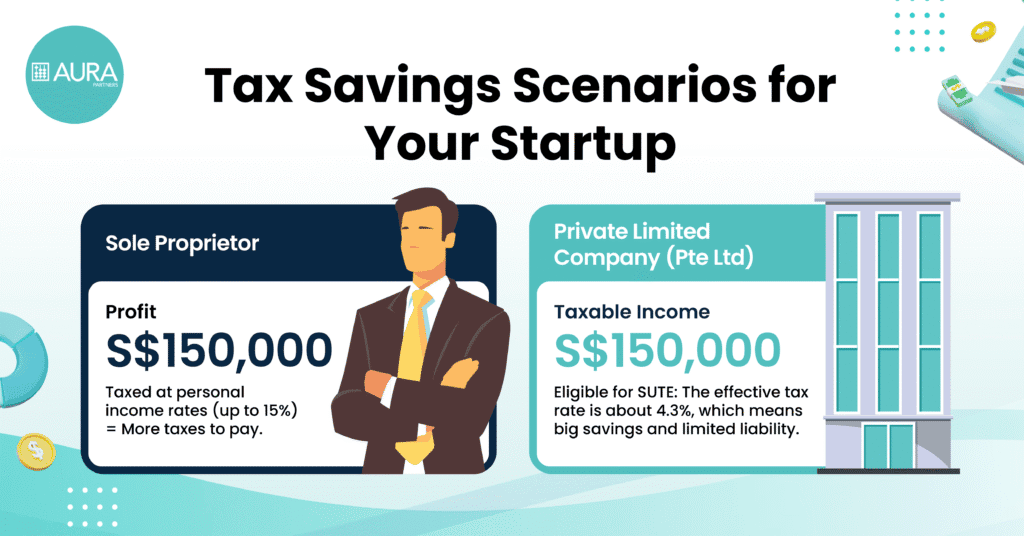
Case Example: Going from a Sole Trader to a Private Limited Company
Situation: Jane runs a successful digital marketing consultancy as a Sole Proprietor. Her business nets a profit of S$180,000. She is considering incorporating as a Private Limited (Pte Ltd) company.
- As a Sole Proprietor: Her entire S$180,000 profit is taxed at personal income rates (up to 22%). Her tax payable would be approximately S$21,200.
- As a Pte Ltd Company (using SUTE): Only a portion of her profit is subject to tax. Her corporate tax payable would be approximately S$9,350.
The Outcome: By incorporating, Jane reduces her tax liability by over S$11,850. More importantly, she gains limited liability protection, separating her personal assets from her business debts, and presents a more professional image to potential clients.
Conclusion: Setting Up for Success
Knowing about corporate tax is more than just following the rules; it’s a way to get ahead. The right structure, combined with a proactive approach to incentives, can preserve crucial cash flow in your early years and set your startup on a path to sustainable growth.
Let Aura Partners Be Your Strategic Tax Advisor
Navigating corporate tax services and planning requires expertise. Mistakes can be costly, and missed opportunities can limit your growth. Aura Partners (Singapore) Pte Ltd provides the strategic tax advisory in Singapore that startups and SMEs need to thrive.
Our services are designed to give you clarity and confidence:
- Corporate Tax Filing & Compliance: Accurate, timely preparation and submission of your corporate tax returns.
- Strategic Tax Advisory: Proactive planning to optimize your structure and maximize your use of incentives like SUTE.
- Withholding Tax Guidance: Ensuring you remain fully compliant with all cross-border payment regulations.
Ready to structure your startup for optimal tax efficiency and growth?
Download our FREE “Startup Tax Optimization Checklist” and schedule a consultation with our corporate tax specialists today.


